
Trust Is the New Currency of Hospitality
- Jul 31
- 4 min read
Why the Next Cyberattack Won't Target Your Hotel—It Will Target Your Guests
For decades, cybersecurity in the hospitality industry was viewed primarily as an IT responsibility.
Hotels invested in stronger firewalls, endpoint protection, security operations centers, and compliance frameworks. Success was measured by how well internal systems were protected against unauthorized access.
Those investments remain essential. But they are no longer sufficient. The rules of cybercrime have changed.
Today's attackers no longer need to compromise a hotel's infrastructure to cause significant financial damage. Increasingly, they achieve the same objective by exploiting something far more valuable than a server. They exploit trust.
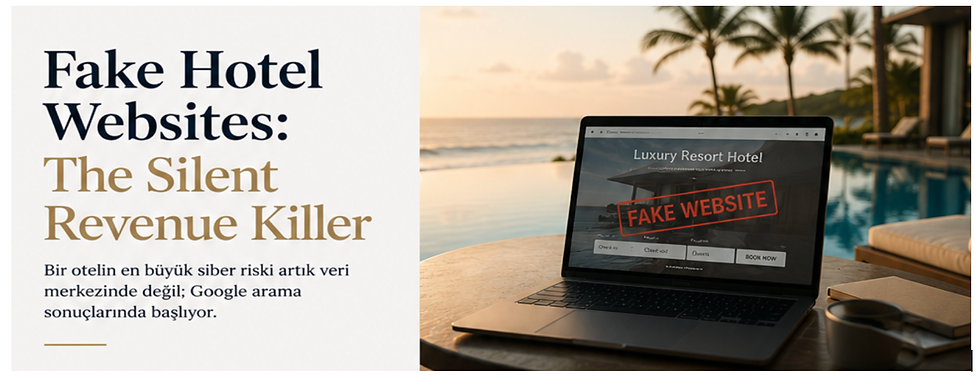
The First Check-in Happens Online
Before guests experience your lobby, your service or your hospitality, they experience your digital presence.
They search.
They compare.
They read reviews.
They click.
The guest journey no longer begins at the reception desk. It begins with a search engine. That seemingly simple shift has fundamentally changed the industry's cyber risk profile.
Today, a convincing fake hotel website, a cloned booking page, an impersonated social media account or an AI-generated phishing campaign can redirect customers long before they ever interact with your organization.
The attacker never needs to breach your network. The customer unknowingly walks directly into theirs. The financial consequences are immediate.
The reputational consequences often last much longer.
Cybersecurity Has Become a Revenue Protection Strategy
Hospitality leaders have traditionally measured performance through occupancy rates, ADR, RevPAR and guest satisfaction. Those metrics remain critical.
However, a new executive question is emerging.
How many potential guests never reached your hotel because they trusted someone pretending to be you?
Few organizations can answer that question. Even fewer measure its financial impact. Yet fake booking websites, domain impersonation, fraudulent advertisements and social engineering campaigns silently divert revenue every day.
Unlike operational losses, these costs rarely appear as a separate line in financial statements.
Instead, they gradually erode customer trust, brand equity and future revenue.
Perhaps the greatest hidden cost is not the fraudulent transaction itself.
It is the guest who decides never to trust your brand again.
Your Brand Is Now Your Largest Attack Surface
For years, cybersecurity focused on protecting infrastructure.
Servers. Endpoints. Cloud workloads. Networks.
Today, the attack surface has expanded dramatically.
Search engines. Social media. Online travel agencies. Domain registrations. Mobile applications. Third-party suppliers. Digital marketing platforms. Executive identities. Artificial intelligence.
Your hotel's digital ecosystem is now significantly larger than your physical infrastructure. Unfortunately, many security strategies have not evolved at the same pace. Organizations continue monitoring what happens inside their networks while attackers increasingly operate outside them.
By the time malicious activity appears in internal security logs, the business impact may already have begun.
The Silent Revenue Killer
Fake hotel websites represent one of the fastest-growing yet least discussed risks facing the hospitality industry. Unlike traditional cyberattacks, they rarely generate operational disruption. There are no encrypted servers. No unavailable systems. No emergency incident response. Business simply continues.
Meanwhile, guests unknowingly book through fraudulent websites. Payments are redirected. Customer credentials are harvested. Brand reputation deteriorates. Revenue quietly disappears.
This is why fake websites should no longer be viewed solely as a cybersecurity issue.They are a business continuity issue.
A marketing issue.
A customer experience issue.
And increasingly, a board-level governance issue.
Waiting for the Dark Web Is Waiting Too Long
Historically, many organizations discovered data breaches only after stolen information appeared on underground forums.
At that point, the incident had already reached its final stage. Modern cyber resilience requires a different mindset. Organizations should not wait for evidence of compromise.
They should identify the weak signals that appear long before public exposure.
A suspicious domain registration. An impersonated executive profile. Abnormal identity behavior. Supplier-related security incidents. Open-source intelligence.
External threat indicators.
Individually, these signals may seem insignificant.
Together, they often reveal the early stages of an emerging attack.
The future of cybersecurity will depend less on generating alerts and more on connecting context.
Cybersecurity Is No Longer an IT Conversation
Perhaps the most significant shift is organizational rather than technological.
Cybersecurity is no longer owned exclusively by technology teams.
It directly affects marketing. Revenue management. Legal. Corporate communications. Investor confidence. Brand strategy. Guest experience.
Ultimately, it affects enterprise value.
This is why cybersecurity should become a standing agenda item for executive leadership and corporate boards.
The strategic question is no longer: "Are our systems secure?"
The better question is:"Is our brand protected wherever our guests encounter it?"
Those are fundamentally different conversations. One focuses on infrastructure. The other focuses on trust.
The Competitive Advantage of the Next Decade
The hospitality industry has invested billions in creating seamless guest experiences.
Smart rooms. Mobile check-in. AI-powered concierge services. Personalized journeys. Digital innovation will continue accelerating.
But none of these investments will achieve their full potential without digital trust.
In the years ahead, guests will not simply choose the best hotel. They will choose the brand they trust the most. That trust will be shaped long before arrival.
It will be shaped by every search result.
Every website.
Every advertisement.
Every booking link.
Every digital interaction.
The organizations that thrive over the next decade will not necessarily be those with the tallest buildings or the most advanced technology.
They will be those that recognize a simple but profound reality:
Cybersecurity is no longer just about protecting systems.
It is about protecting confidence.
Because in today's hospitality economy, the most valuable reservation is not secured by a credit card. It is secured by trust.
Comments